
The Stroke Excuse
Why "use clinical judgment" is the most useless piece of medical advice nobody's calling out

Melissa had a TIA three years ago. A transient ischemic attack. A “mini-stroke,” as her neurologist called it, though she told me that name had always bothered her because there was nothing mini about the terror of losing feeling in her left hand for three hours and not knowing if it was coming back.
She’d recovered fully. No lasting damage, good follow-up care. And then she went into perimenopause, and her world fell apart in a different way. Insomnia. Raging hot flashes and night sweats. Brain fog so thick she had to quit her job. She went to her OB, who looked at her chart, saw the TIA history, and said: no estrogen. She went to her neurologist. Same answer. She went to a third doctor who told her she could “explore non-hormonal options,” handed her a printout about black cohosh, and sent her on her way.
I don’t blame any of those doctors. I blame the system that left them no other reasonable choice.
Here’s how that system works. Meet Dr. Brain.

Dr. Brain Has One Job
Dr. Brain is a neurologist. He’s good at his job. He saw you after your TIA, ordered the right workup, identified the contributing factors, and put you on the appropriate secondary prevention medications. He genuinely cares about you. He does not want you to have another stroke.
You come back to his office six months later and tell him you’re struggling. The night sweats are relentless. You’re sleeping in two-hour stretches. You can’t concentrate well enough to do your job. You ask, “Is there any way I could take an estrogen patch?” (Which you’ve heard is the lowest risk form of estrogen)
Dr. Brain does what any conscientious physician does. He looks at the FDA label for transdermal estradiol. Unfortunately, despite changes to the black box warning, the label for transdermal estradiol says that estradiol is contraindicated in women with active arterial thromboembolic disease (for example, stroke or heart attack) or a history of these conditions. Weirdly, the updated label for oral estradiol only contraindicates for heart attacks or stroke within the last year, but the estradiol patch label still says that if you have a history of these conditions at all, you can’t take the drug.
You have a history. Box checked. Contraindicated.
He pulls up a quick search. He finds language, noting that high-dose transdermal estradiol may be associated with increased stroke risk. He finds guidelines recommending that clinicians “weigh risks and benefits” and conduct an “individualized assessment.” He finds a trial studying estrogen in women with prior stroke that found excess events in the first six months.
None of this comes with a footnote explaining that the trial used oral estradiol in 71-year-olds. None of it flags that the “high-dose transdermal” risk comes from one observational study that didn’t account for the type of progestogen used alongside the estrogen. The guidance reads: "There is risk here; use judgment.”
So Dr. Brain uses judgment. He has one job, one singular clinical responsibility in his relationship with you: protect your brain from another stroke. Your hot flashes are miserable. Your insomnia is destroying your quality of life. Your bones are quietly losing density. You’ve become pre-diabetic and hypertensive. He may care about all of this. But it is not his brain. It is not his specialty. It is not the thing he will be held accountable for if something goes wrong.
Here’s the quiet irony he may or may not be aware of. Those night sweats he’s dismissing as a quality-of-life issue? Frequent, severe vasomotor symptoms are independently associated with increased stroke risk (more on that below). The pre-diabetes and hypertension he’s filed under “someone else’s problem”? Both accelerate the vascular disease he’s trying to prevent. The estrogen deficiency driving all of it isn’t just making you miserable right now. It’s quietly working on your brain.
Dr. Brain’s job is to protect your brain. The evidence increasingly suggests that estrogen, delivered correctly, may be part of how you do that. But none of that makes it into his calculation. Because the label says estrogen may increase the risk of stroke. And the clock on his appointment stopped ticking ten minutes ago.
If he signs off on estrogen and you have another TIA (or worse), he agreed to a medication against a formal FDA contraindication in a patient with a documented history of the exact condition listed in that contraindication. In a clinical area outside his specialty. Based on his own reading of a literature he isn’t an expert in. That is a medical malpractice case with his name on it. And he knows that just having had one TIA already puts you at higher risk for another, regardless of how carefully he’s managed your care.
If he says no, he loses nothing. You go home frustrated, underserved, and still having hot flashes. None of that shows up in his outcome metrics. None of that is his liability.
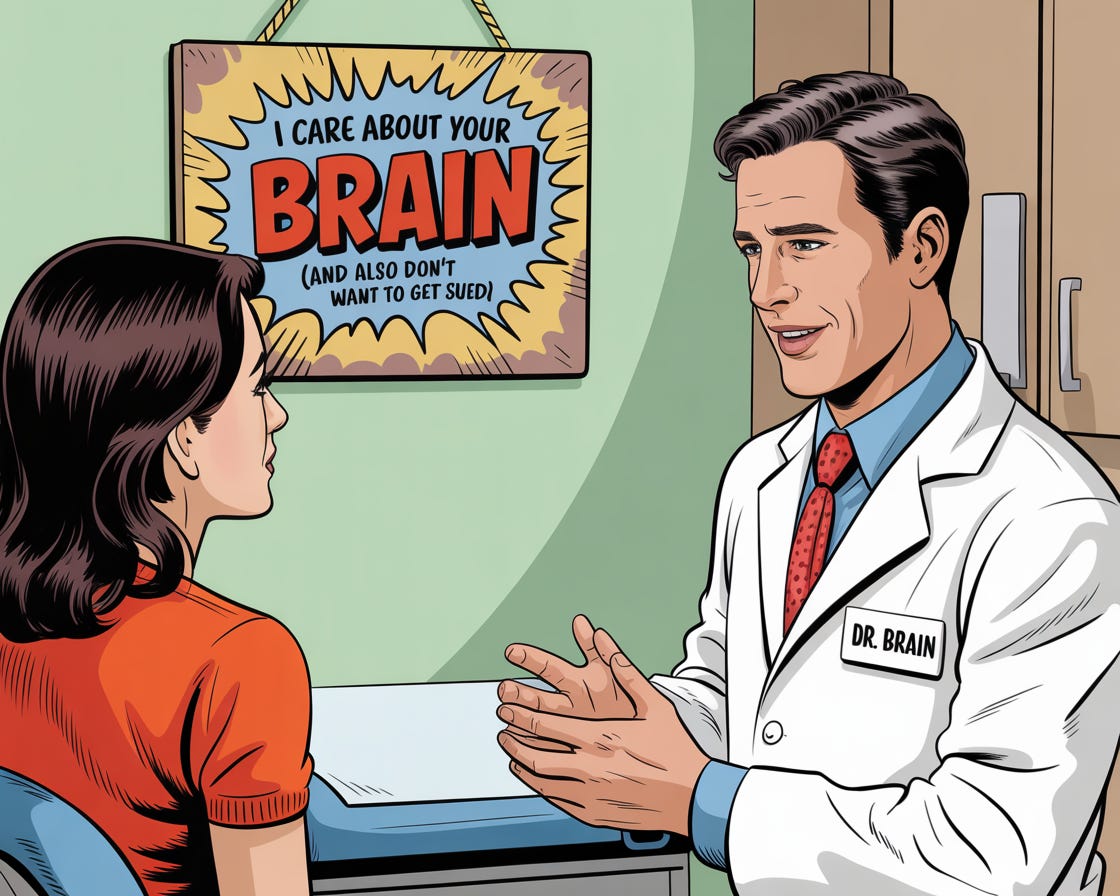
There is no version of this incentive structure that produces a yes.
Dr. Brain is far from alone in this. Substitute him for an oncologist seeing you after breast cancer. The new FDA label may no longer flag increased breast cancer risk, but that oncologist is still going to say no, especially if your cancer was ER-positive. Or substitute him for a hematologist who treated your DVT two years ago. Or a neurologist managing your migraines with aura. Every specialist has one job, one narrow mandate. Your hot flashes, your sleeplessness, your dissolving bone density, your quality of life: not their organ. And the label, the guidelines, and every AI search tool they open will confirm that “no” is the safe answer.
None of these physicians is the villain. The villain is a label written from the wrong data, amplified by guidelines that mistake vagueness for caution, and handed to specialists who were never trained in menopause medicine and aren’t being asked to manage it now.
“Use clinical judgment” only works if the person being asked to use it has accurate information to work with. Right now, they don’t. And women are paying for it.
So let’s talk about what the evidence actually shows regarding stroke risk with transdermal estradiol. Because it is substantially different from what the label implies.
