


Four times a year, for years, a handful of my patients pointed their cars toward Utah and drove in from Wyoming. Past every clinic and compounding pharmacy in two states. An eight-hour round trip, on purpose, so I could make a tiny nick in the top of a hip and tuck in a few grains of crystallized hormone the size of rice. They’d done the creams. They’d done the patches and the pills. Nothing else touched it. So they gassed up the car and came.
I placed pellets for years. Thousands of them. And I’m about to defend the one hormone delivery method that half of organized medicine treats like a scandal you’re supposed to whisper about at conferences. Fair warning: I’ll also tell you why they usually aren’t my first pick anymore. Both things are true, and if that sounds like a contradiction, welcome to hormones. Stay with me.
First, what even is a pellet?
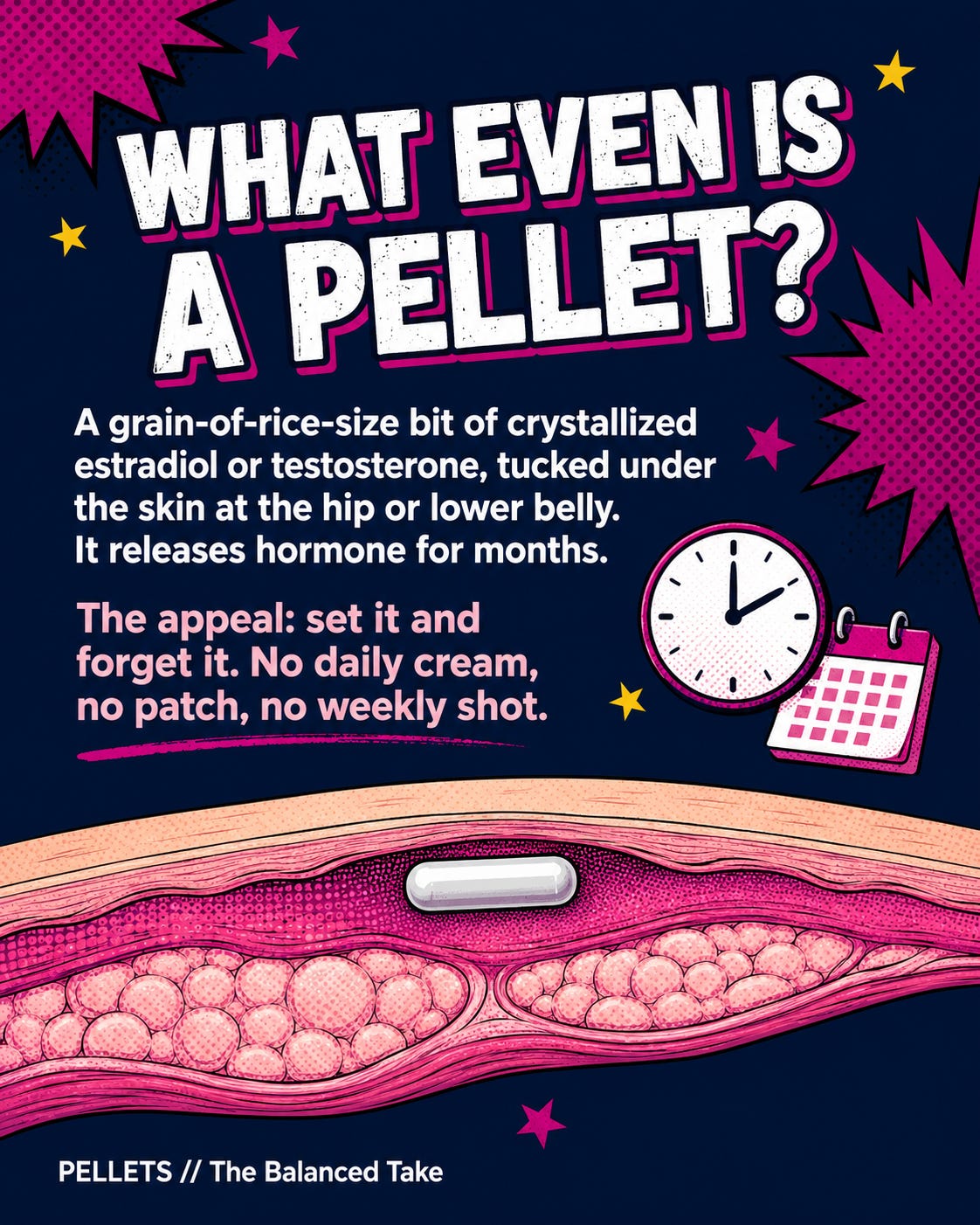
A pellet is a little cylinder of crystallized hormone, estradiol or testosterone, pressed into something about the size of a fat grain of rice. Your clinician numbs a patch of skin with a bit of lidocaine, makes a nick, and slips one (or a few) into the fat just under the surface, usually at the upper outer hip or the lower belly. A few minutes, start to finish. Then the pellet sits there and quietly dissolves, releasing a steady trickle of hormone for months before it’s gone.
That’s the whole technology. It’s been around since the 1940s, which makes it older than the patch, older than the gel, and older than most of the doctors currently frightened of it.
So why would a woman choose this over a cream she rubs on every morning? Three words. Set and forget. No daily ritual, no patch curling off at the pool, no weekly needle. My military patients adored them, because “apply your compounded cream at the same time every day” is a big ask when you’re deployed somewhere with sand in everything. But plenty of civilian women loved them too, for the deeply relatable reason that they were flat-out tired of managing one more thing. You get it placed, and then for three to six months, you don’t think about your hormones at all. For the right woman, that isn’t laziness. That’s freedom.
Are pellets safe?
This is the whole ballgame, so let’s take it seriously, piece by piece, because there are two completely different things people mean when they ask.
The first is about the procedure. You’re tucking a foreign object under someone’s skin, so the fair things to ask are: will it get infected, and will it wander back out (that’s called extrusion, and yes, it’s exactly as annoying as it sounds). Both can happen. Both are rare. In thousands of insertions across my career, I had one extrusion, in a man packing a row of man-sized pellets (male doses use more and bigger pellets than any woman will ever get). Infections? Zero. Not because I have magic hands, but because these problems are uncommon to begin with, rarer in women than in men, and rarer still when the person holding the trocar knows the pointy end from the plunger. Across the literature, done well in women, you’re looking at infection somewhere around 0.3 to 1.2 percent and extrusion around 0.8 to 5 percent. Small numbers.
The second is the one I lose sleep over. It’s not the procedure. It’s too much hormone, at a moment when you can’t hand it back.
Once a pellet is in, it’s in. If the dose lands too high, there’s no scraping it back out, so your patient rides out weeks or months of side effects she never signed up for. Too much testosterone looks like acne, backne (yes, that’s a word now), and a libido that’s gone from “oh good, it’s back” to “this is a lot,” possibly with a guest appearance from a faint upper-lip mustache. Rarely dangerous. Frequently miserable. And you can’t just stop. Too much estradiol shows up as vaginal bleeding, usually just a nuisance, but if it drags on or turns up in a woman with risk factors, it buys her a workup and an ultrasound to make sure the lining of her uterus is behaving. That bleeding is the endometrium answering estrogen that progesterone isn’t there to balance. Hold that thought.
This is why every careful pellet decision is really a dosing decision, and why I start women lower than I think they’ll end up needing. You can always add. You can never subtract.
So strip the question down to the studs and you find two fair worries. The first is irreversibility, which we just covered. You can’t take it out. (Funny thing: we accept that exact bargain elsewhere and nobody blinks. Depo-Provera locks in three months of hormone you can’t recall, and it’s sitting in pharmacies right now without a warning label shaped like a pitchfork.) The second is that the big trials were never run on pellets. Almost no placebo-controlled trials of pellets in women exist. The landmark estrogen studies ran on pills and patches, and what we’ve got for testosterone in women runs mostly on gels and patches. That’s a real gap. But a gap in the evidence is missing proof, not proof of harm.
