


Anytime I write a Substack article or put out an Instagram post on hormone levels, such as my recent “Bone of Contention” article or my fan-favorite “Why Won’t Anybody Tell Me The Optimal Serum Estradiol?” article, I get a flood of questions.
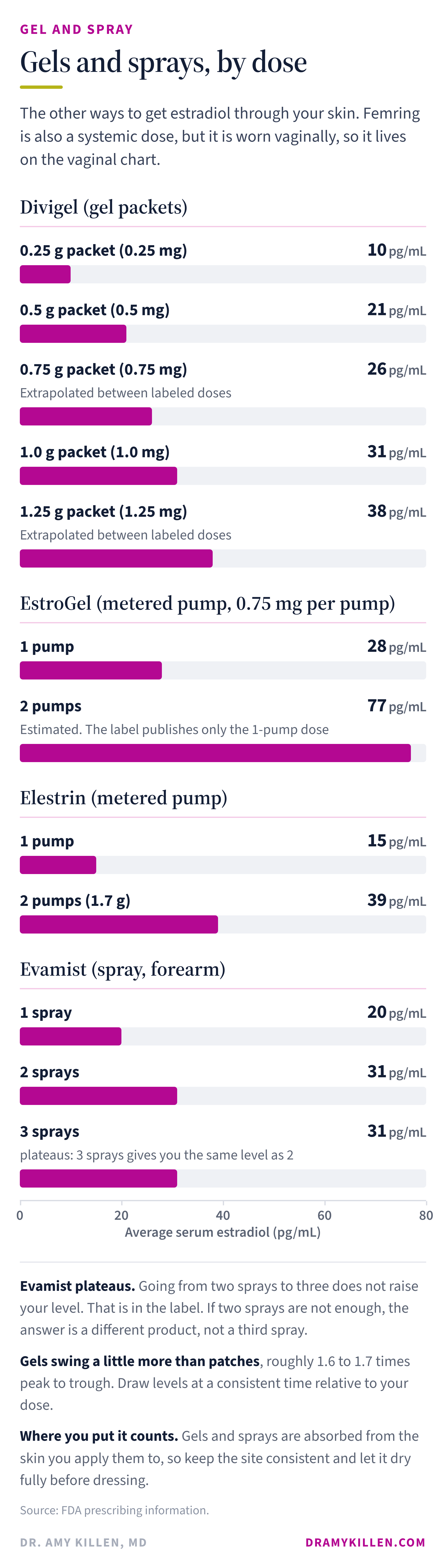
“But what if I’m taking two pumps of estradiol gel, 0.75 mg per pump?”
“What does that mean for me? I’m on Delestrogen 10 mg monthly.”
“How about Bijuva 0.5 mg?”
Fair. All of them. You want to know what your particular prescription is actually doing inside your body, and whether it’s enough estrogen to protect your bones, your brain and your blood vessels. Nobody ever handed you the translation key.
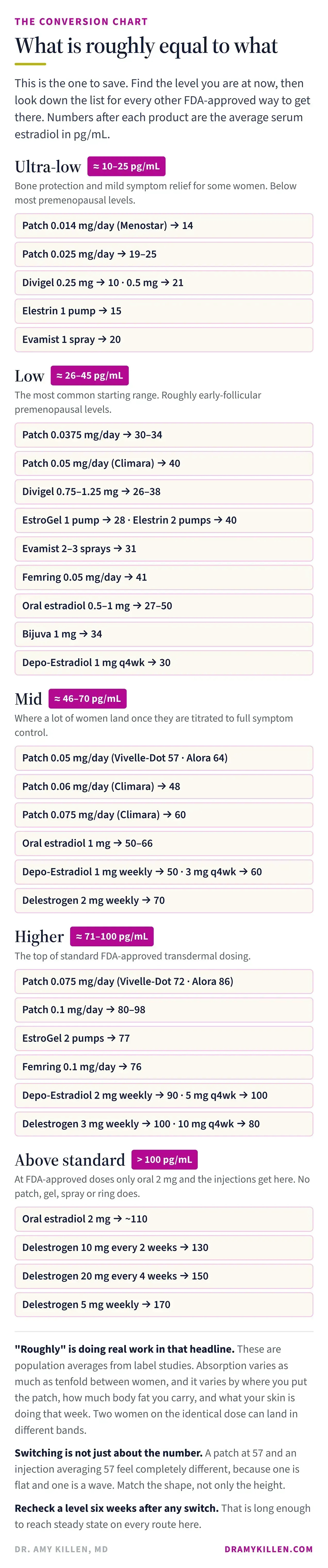
So this week is light on words and heavy on charts. Find your dose. Find your route. See where you land.
A few things to know
I built these charts myself, using published pharmaceutical data.
Manufacturers don’t report their numbers the same way, and the differences aren’t small. Bijuva’s label shows steady-state estradiol curves adjusted for baseline (drug only, your own leftover estrogen subtracted out). EstroGel’s label shows unadjusted curves (drug plus whatever you were already making). Food matters too. Bijuva taken with a high-fat meal has an estradiol peak roughly half of what it is fasting, which happens to be exactly how the drug is labeled to be taken.
Absorption through skin is variable, and published data tells you nothing about what YOU are absorbing. EstroGel’s pharmacokinetic numbers come from 24 postmenopausal women who applied it to one arm, wrist to shoulder, under supervision. Your skin, your application site, your body composition, your lotion. All of it moves the number.
Every dataset comes with a pile of numbers that are not interchangeable: peak level, time to peak, average level across the dosing interval, and half-life. One pump of EstroGel produces a mean peak of 46.4 pg/mL on day 14 and a 24-hour time-averaged level of 28.3 pg/mL. Same woman, same dose, same day, nearly two-fold apart depending on which number gets printed. Levels also climb over the first days of daily dosing before they plateau, so a first-dose number and a steady-state number are different animals. And with a monthly injection, your level depends almost entirely on where you are in the month when blood gets drawn.
Your lab isn’t neutral either. Standard immunoassays get unreliable at the low estradiol concentrations most postmenopausal women live in. If you’re comparing your result to a chart, the assay matters as much as the dose. In general, LC-MS is better.
These charts are a map, not a mirror. First, is a general comparison. If you want more detail, keep scrolling!
Transdermal Estradiol
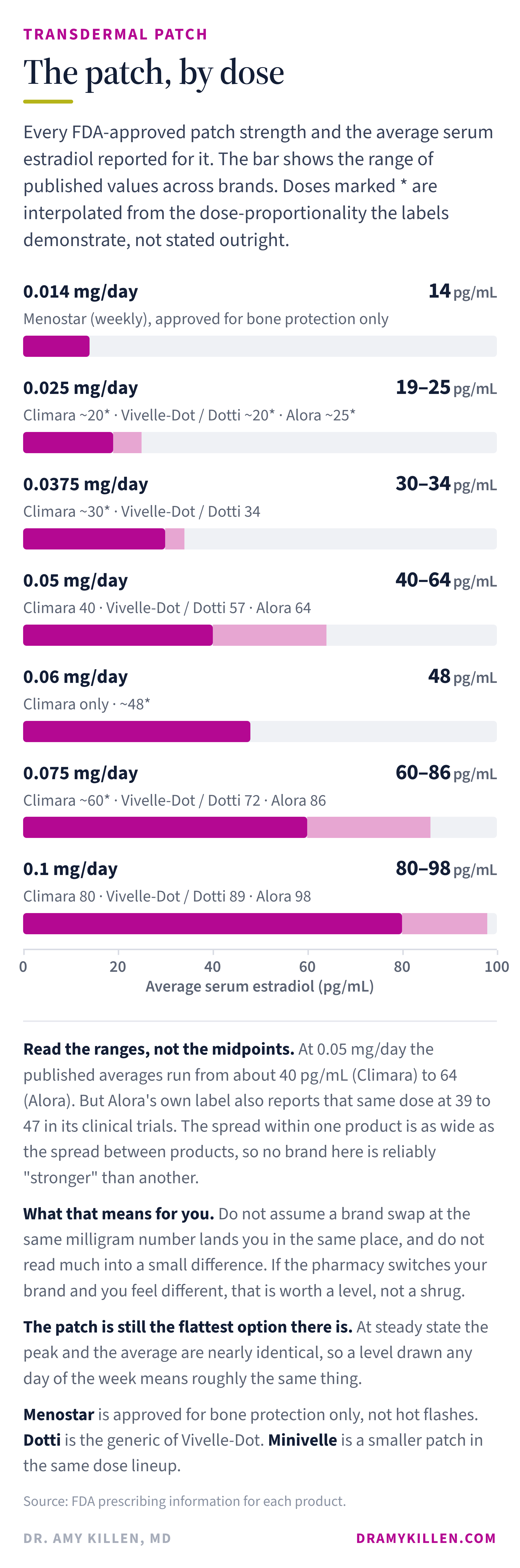
Now, let’s get into the specific forms. The next two sections are the transdermal options: Gels, sprays and patches. As a reminder, transdermal estradiol does not undergo the first-pass effect through the liver, so it does not increase blood clot risk and is the safest form if you’re starting hormones “late” (more than 10 years from menopause onset).
Oral Estradiol
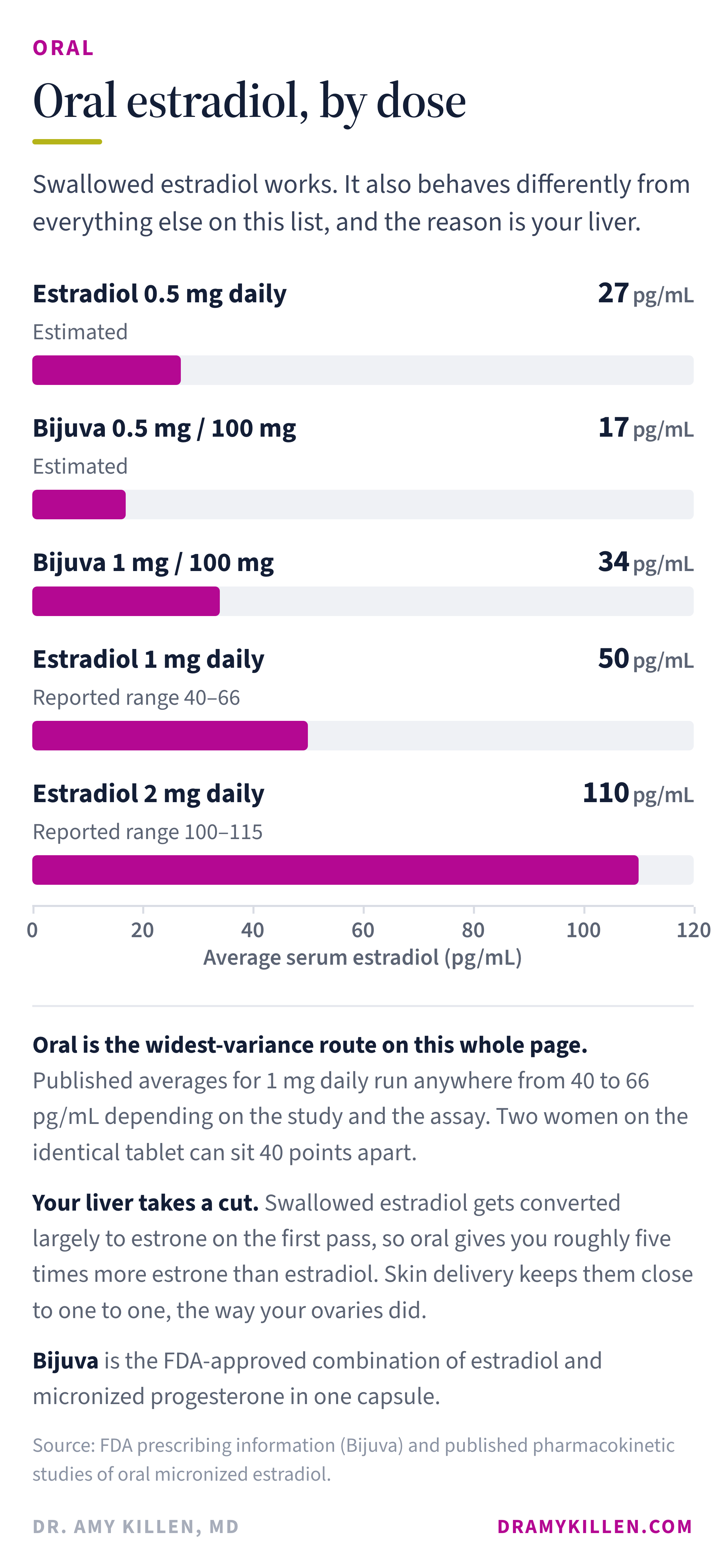
Next up is oral estradiol. It’s inexpensive and easy to find. But oral estrogens carry an increased risk of blood clots (especially conjugated equine estrogen, or Premarin, but probably also oral estradiol). Oral estradiol will also increase SHBG, a binding hormone that can reduce your free (active) testosterone. That said, I love oral estradiol for the right woman.
Estradiol Injections
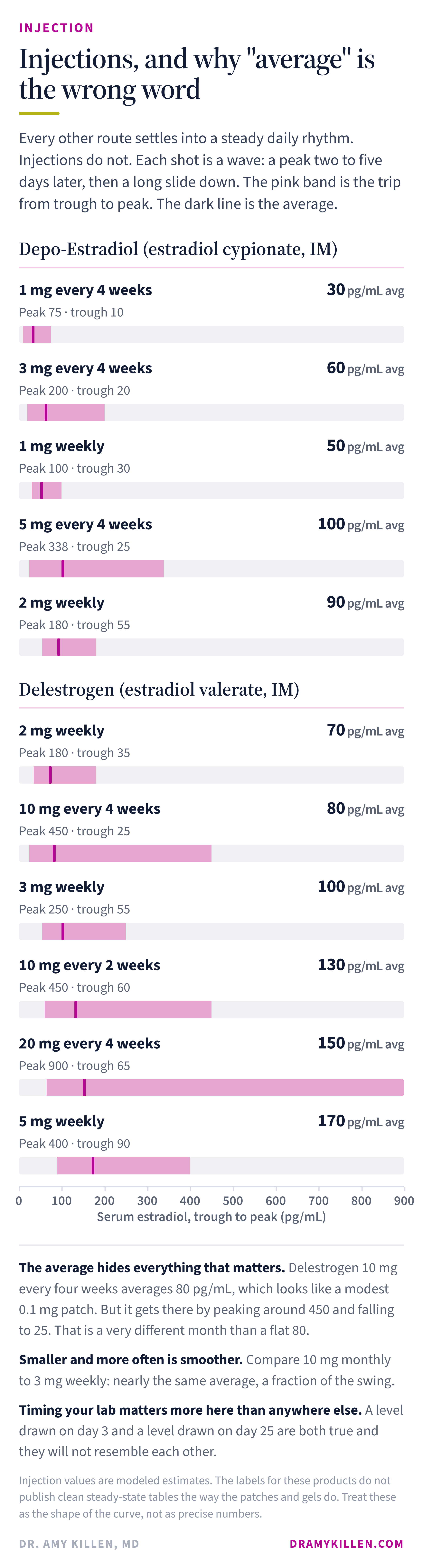
Next, we have the estrogen injections. Injectable estradiol comes as an ester (estradiol valerate or estradiol cypionate), which is estradiol with a fatty acid chain attached to slow its release. Like transdermal, injections skip the first-pass trip through the liver, which is the mechanism behind oral estrogen's clot risk. So the expectation is that they behave like a patch rather than a pill, though nobody has run the study to prove it. The upside is reliability: no skin absorption lottery, no daily application, and easy to get levels up in women whose skin simply won't cooperate. The downside is the ride. A monthly injection peaks high and then crashes, which means your symptoms can track the calendar, and your lab value depends almost entirely on which week you get drawn. Smaller doses given weekly or twice weekly flatten that curve considerably.
Vaginal Estrogen
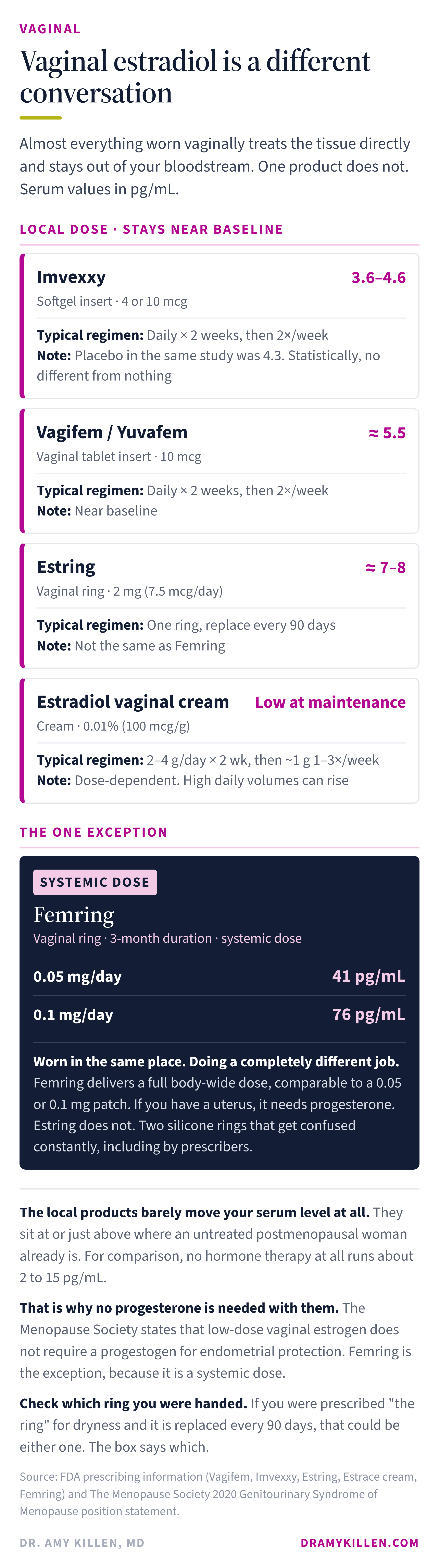
And it wouldn’t be an estrogen article without vaginal estrogen. Here, the dose decides everything. Low doses (the 10 mcg inserts, Estring, a small amount of 0.01% cream) work mostly where you put them, on vaginal, urethral, and bladder tissue, and barely move your serum estradiol, as you’ll see below. Barely, not zero. Absorption runs highest in the first week or two, when the tissue is thin and permeable, then drops off as it thickens. Levels stay in the postmenopausal range.
Higher doses are a different drug wearing the same costume. Femring releases 0.05 or 0.1 mg of estradiol per day, is FDA approved for hot flashes, and carries the same boxed warning as a pill. If you have a uterus, it needs endometrial protection (with progesterone), and it belongs on your chart as systemic therapy.
The flip side is that low-dose vaginal estrogen won’t touch your hot flashes and won’t do a thing for your bones.
Putting it All in Context
So now you have a number, or at least an estimate of one. Which raises the obvious question: Is it a good number?
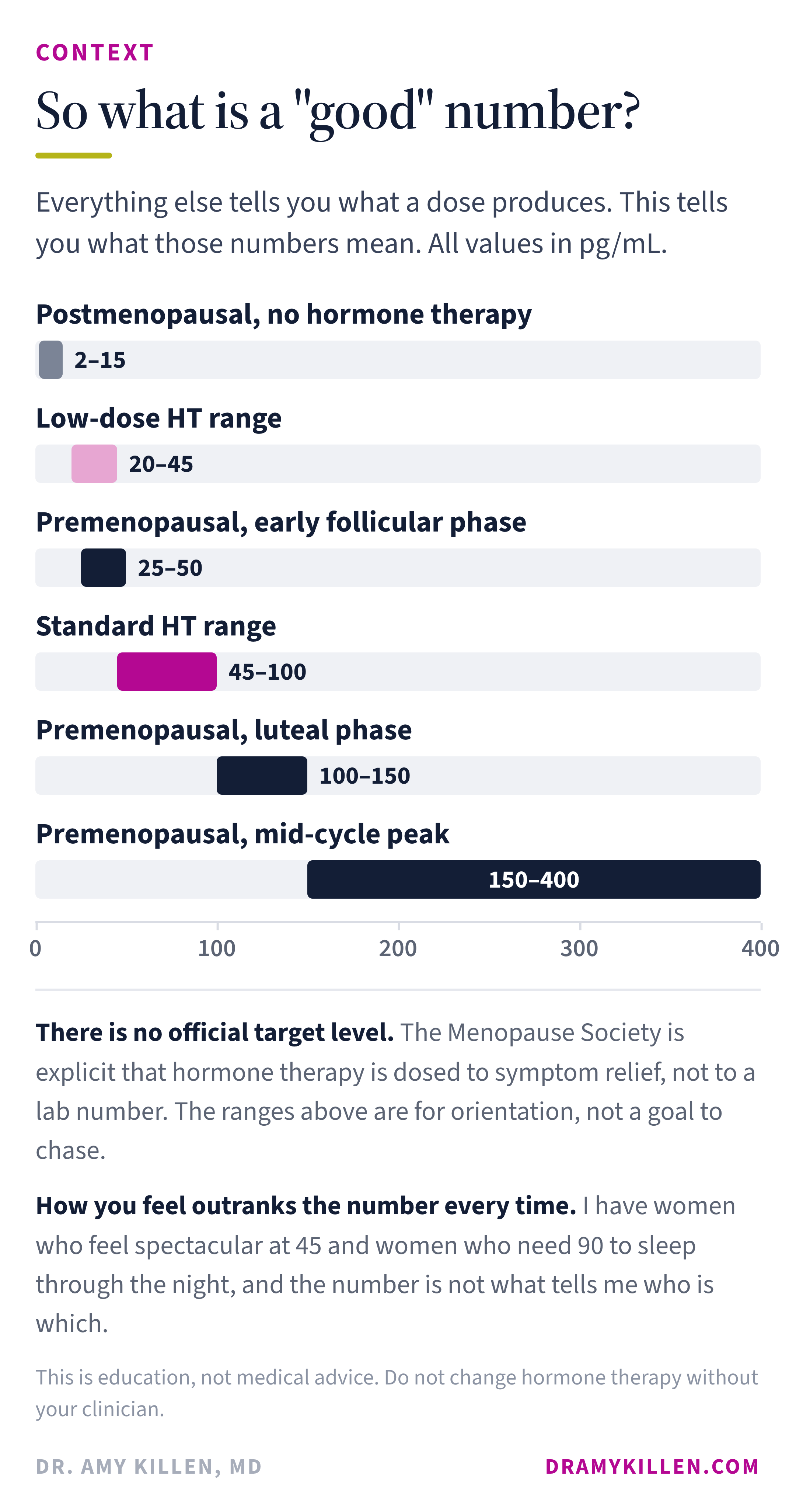
Here’s the context nobody hands you. Premenopausal women don’t live at one estradiol level. They live across a range that swings close to tenfold in a single month, from the mid-20s in the early follicular phase to a few hundred at ovulation. Hormone therapy doesn’t recreate that. It picks a spot and holds it.
Where that spot should be is not settled, and there is no official target. In general, I aim for about 65-150 pg/mL (you can read the “why” in my previous Substack HERE), but this is not an established guideline.
The Wrap Up:
The charts above (aren’t they pretty?) will get you an estimate. An estimate is not a measurement. The only way to know what you’re actually running is to draw a level.
Nobody requires this, and plenty of doctors won’t do it. I think it’s worth doing anyway, and the argument gets stronger the further your reasons for taking hormones drift from symptom relief. If you’re dosing to feel better, your symptoms are a reasonable readout. If you’re dosing to protect your bones, your brain, and your blood vessels thirty years from now, symptoms tell you nothing at all. There is no hot flash that reports on your femoral neck.
If you do draw a level, timing is most of the battle. For daily transdermal or oral use, draw midway between doses. For injections, note where you are in the cycle and draw at the same point every time (I prefer drawing about mid-way between doses). And ask for LC-MS/MS if your lab offers it.
If your doctor doesn’t know how to prescribe hormones but wants to learn, send her my way. You can nominate her anonymously HERE, and she’ll get information about my Hormone Optimization Therapy (HOT) Provider virtual training course, along with a discount.
The chart gets you close. Your blood tells you the truth.
Sources:
### Transdermal patch
- **Menostar** (estradiol transdermal system, 0.014 mg/day). Bayer HealthCare. Prescribing information, section 12.3. Geometric mean C<sub>avg</sub> 13.7 pg/mL in 18 postmenopausal women, abdominal application.
- **Climara** (estradiol transdermal system). Bayer HealthCare. Prescribing information, section 12.3. Mean steady-state C<sub>avg</sub> approximately 40 pg/mL for the 12.5 cm² system (0.05 mg/day) and approximately 80 pg/mL for the 25 cm² system (0.1 mg/day). C<sub>max</sub> approximately 100 pg/mL and C<sub>min</sub> approximately 35 pg/mL for the 25 cm² system.
- **Vivelle-Dot** (estradiol transdermal system). Sandoz. Prescribing information, Table 2, steady-state parameters for abdominal application, not corrected for baseline (mean baseline 11.7 pg/mL). C<sub>avg</sub>: 0.0375 mg/day = 34; 0.05 = 57; 0.075 = 72; 0.1 = 89 pg/mL. **Dotti** is the generic of Vivelle-Dot and carries the same data.
- **Alora** (estradiol transdermal system). Prescribing information, Table 1, abdominal application, multiple dosing. C<sub>avg</sub>: 0.05 mg/day = 64; 0.075 = 86; 0.1 = 98 pg/mL. The same label’s Table 2 reports the 0.05 mg/day dose at 38.8 to 46.9 pg/mL across three clinical trials, and reports baseline-adjusted steady-state values of 18.6, 35.9 and 50.1 pg/mL for 0.025, 0.05 and 0.075 mg/day. This is why the patch chart shows a range and why I do not claim any brand is reliably stronger than another.
Doses marked with an asterisk in the patch chart (0.025, 0.0375, 0.06 and 0.075 mg/day for Climara) are interpolated from the dose proportionality those labels demonstrate, rather than stated outright.
### Gel
- **Divigel** (estradiol gel 0.1%). Prescribing information, Table 2, day 14, uncorrected for baseline. C<sub>avg</sub>: 0.25 g = 9.8; 0.5 g = 21; 1.0 g = 30.5 pg/mL. The 0.75 g and 1.25 g values shown in the chart are interpolated between these, not label-stated.
- **EstroGel** (estradiol gel 0.06%). Ascend Therapeutics. Prescribing information, section 12.3. One pump (1.25 g, 0.75 mg estradiol) gives a time-averaged serum estradiol of 28.3 pg/mL over 24 hours at day 14, with C<sub>max</sub> 46.4 pg/mL. **The label does not publish a C<sub>avg</sub> for the two-pump (2.5 g) dose**; the 77 pg/mL shown is an estimate and is flagged as such in the chart.
- **Elestrin** (estradiol gel 0.06%). Viatris. Prescribing information, Table 2, unadjusted, after 14 days. C<sub>ave</sub>: 0.87 g = 15.4; 1.7 g = 39.2 pg/mL. The same table reports an estradiol-to-estrone ratio of 0.53 at the lower dose and 0.98 at the higher, the latter matching an early-follicular premenopausal ratio.
### Spray
- **Evamist** (estradiol transdermal spray). Padagis. Prescribing information, Table 2, day 14, unadjusted for baseline. C<sub>avg</sub>: 1 spray = 19.6; 2 sprays = 30.7; 3 sprays = 30.9 pg/mL. The plateau between two and three sprays is the label’s own finding, not my inference.
### Oral
- **Bijuva** (estradiol and progesterone capsules, 1 mg/100 mg). Prescribing information, Table 2, day 7 steady state, baseline unadjusted. Estradiol C<sub>avg</sub> 33.99 pg/mL, C<sub>max</sub> 42.27, t<sub>max</sub> approximately 5 hours, effective half-life approximately 26 hours. Estrone C<sub>avg</sub> 192.1 pg/mL, which is the source of the estrone point in the oral chart.
- **Generic oral estradiol** (micronized 17β-estradiol tablets). The tablet labels do not carry a comparable steady-state pharmacokinetic table, so the 0.5, 1 and 2 mg values are drawn from the published literature on oral micronized estradiol, where reported means for 1 mg run from roughly 40 to 66 pg/mL and 2 mg runs near 100 to 115 pg/mL, with serum estrone at 2 mg reported near 575 pg/mL. These are the widest-uncertainty numbers on the page and are labeled as ranges in the chart.
### Injection
- **Delestrogen** (estradiol valerate) and **Depo-Estradiol** (estradiol cypionate). These labels do not publish steady-state pharmacokinetic tables comparable to the transdermal products. The peak, trough and average values in the injection chart are **modeled estimates** based on the known shape of an oil-depot curve and published single-dose data. They are intended to show the shape of the curve and the relative effect of dose and interval, not to be read as precise numbers. This is stated on the chart itself.
### Vaginal
- **Vagifem / Yuvafem** (estradiol vaginal inserts, 10 mcg). Novo Nordisk. Prescribing information, Table 2, uncorrected for baseline. Estradiol C<sub>ave</sub> 10.09 pg/mL at day 1, 7.35 at day 14, and 5.50 at day 83 on twice-weekly maintenance.
- **Imvexxy** (estradiol vaginal inserts, 4 and 10 mcg). Mayne Pharma. Prescribing information, Table 2, day 14, unadjusted for baseline. Estradiol C<sub>avg</sub> 3.6 pg/mL for 4 mcg and 4.6 for 10 mcg. **Placebo in the same study was 4.3 pg/mL.**
- **Estring** (estradiol vaginal ring, 2 mg, releasing approximately 7.5 mcg/day). Pfizer. Prescribing information, section 12.3 and Table 1. Mean steady-state serum estradiol of 7.8, 7.0, 7.0 and 8.1 pg/mL at weeks 12, 24, 36 and 48. Baseline-adjusted, the 12-week steady-state value is 0.4 pg/mL. Approximately 8 percent of the estradiol released locally is absorbed systemically.
- **Estradiol vaginal cream, 0.01%**. Prescribing information. Systemic absorption is dose-dependent and rises with larger and more frequent applications, which is why the chart flags it rather than giving a single number.
- **Femring** (estradiol acetate vaginal ring). Millicent. Prescribing information, section 12.3 and Table 2. Average serum estradiol 40.6 pg/mL for the 0.05 mg/day ring and 76.0 pg/mL for the 0.1 mg/day ring. Note the initial-release C<sub>max</sub> of 1129 pg/mL in the first hour after insertion, which settles within 24 to 48 hours.
### Guidance and context
- **The Menopause Society** (formerly NAMS). *The 2020 Genitourinary Syndrome of Menopause Position Statement.* The basis for the statement that low-dose vaginal estrogen produces serum estradiol within the normal postmenopausal range and does not require a progestogen for endometrial protection.
- **The Menopause Society.** *The 2022 Hormone Therapy Position Statement.* The basis for the statement that hormone therapy is dosed to symptom relief rather than to a target serum level.
- Premenopausal cycle reference ranges in the context chart are conventional clinical values, included for orientation only.
---
*Compiled by cross-checking each product’s current FDA prescribing information via DailyMed and the FDA Drugs@FDA label archive. Where a label’s value and a widely-circulated figure disagreed, I used the label.*
*This post is education, not medical advice. Nothing here is a substitute for a conversation with your own clinician, and no one should change a hormone regimen based on a chart on the internet.*
This is an incredibly helpful resource. Thank you for taking the time (and brainpower!) to share this information with so many of us. 💕
This. Is. Amazing. ❤️